
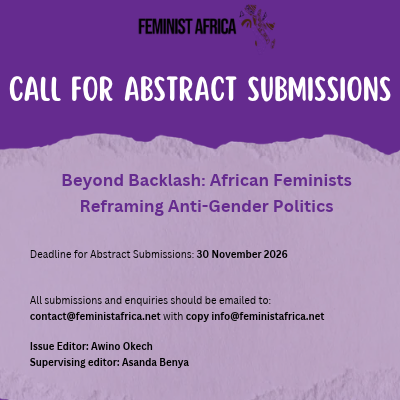
Deadline for Abstract Submissions: 30 November 2026
All submissions and enquiries should be emailed to: contact@feministafrica.net with copy info@feministafrica.net
Issue Editor: Awino Okech. Supervising editor: Asanda Benya
Introduction
Across Africa, anti-gender and anti-rights mobilisation has become increasingly visible within political, religious, educational and media spaces. These mobilisations frequently organise around opposition to sexual and reproductive health and rights, LGBTQ+ rights, comprehensive sexuality education, feminist organising and the language of gender itself. These campaigns are connected through transnational advocacy networks, shared narratives and forms of policy diffusion across Eastern, West and Southern Africa. Recent initiatives organised around “family values”, sovereignty and resistance to supposedly external gender norms further illustrate the increasing institutionalisation of these agendas.
There are several analytical moves invoked through these campaigns and movements but three are foregrounded here. The first is the construction of the family as a singular, apolitical, natural institution grounded in an unchanging heterosexual unit. Second, is the conversion of gender and sexuality rights, including those concerning heterosexuality, into a threat to the family. Third, converting bodily autonomy into a sovereignty question linked to the identity of a people that therefore falls within the purview of institutions (Kanchan, 2026).
There is significant work documenting these movements: their funding, transnational networks, religious infrastructures, political strategies and effects on gender and sexual rights. Yet an exclusive focus on anti-gender actors can obscure a much longer and richer history of African feminist intellectual production, political organising and narrative contestation. African feminists have continuously produced alternative accounts of freedom, family, sexuality, community, citizenship, justice and African political futures. From the Charter of Feminist Principles for African Feminists to contemporary feminist organising, African feminisms have articulated a politics committed to dismantling patriarchy while simultaneously challenging colonialism, racism, capitalism and other structures of domination. Through coalitions, litigation and advocacy to contest anti-LGBTQ+ legislation in Kenya, Uganda, Ghana and civil society observer status at the African Commission on Human and Peoples’ Rights, feminist movements and scholars have challenged a wave of attacks on bodily autonomy across the continent. These have been coupled with community-level work, provision of alternative knowledge and services, public health advocacy, comprehensive sexuality education and a grassroots social-justice approach in politically hostile environments (African Union Executive Council, 2019; Odoi et al., 2024; Oloka-Onyango et al., 2014)
Read the full Call for Papers here